What “Motel View” Knows About Marketing: Favatars 2010

Aug 26
2010

Eighteen years ago, Forbes Williams wrote a book called Motel View. It’s a collection of stories and my mother gave me a copy when I was fourteen. I don’t know how many times I’ve read it, but some of the stories are as familiar to me as well-known songs. My favourite is about the invention of an imaginary athlete named Stan Malone.

Williams’ protagonist, a sixteen year old named Paul, lives with two flatmates in the hills above Wellington. Bored and creative, the trio embark on a project to invent news stories and have them feature on the national news, and they succeed: once with a fictitious small plane crash, and once with a middle distance runner who was eventually selected to carry the New Zealand flag at the Olympic Games.

Williams’ characters faxed Malone’s imaginary times to New Zealand newspapers, who then published them in the small-print results on sports pages. However, when Malone’s name was left off the team for the upcoming Olympics, there began a national outcry. He was substantially quicker than most of the country’s talent; why was he not to compete?

You couldn’t do exactly this today: the Internet invented real time results reporting (like this and this), Ustream web broadcasts through which I’ve watched events from Texas whilst sitting in London, and instantaneous results syndication, ensure more honesty in sports reporting. Malone’s existence would be discredited pretty quickly. However, Williams’ characters did several things right, given their time and place, in their invention of Malone that heightened his chances of succeeding.

The makers of this Facebook profile did not.

People unfortunate enough to be embroiled in the fake avatars scandal of 2008 may remember that two years ago, social media avatars were the order of the day amongst those who shouted the loudest. “Fake avatars” referred to social media profiles that weren’t portraying real people. Created with the mind to promote something, these soulless shells presumably blended in to your Facebook and Twitter world the way the droids do to your cross-stitch group before they take over your frontal lobe.

This is assuming that the favatars appeared real. The profile above was brought to my attention yesterday by our favourite Frenchman, Ciaran Norris. That’s me in the photo, along with Lisa Myers, at a party in Edgware Road, London, in 2007.

The fake picture along with the “likes” and interests of this girl (which she shares with some of her equally fake-looking friends) are stereotypically generic. My best guess is that this was created by Al Marketing Guy in his cubicle, and he thought: “What do blond 23 year olds like?” (We so do still look 23. Yes we do, damn it). He came up with Pink, Beyonce, their mums, breast cancer awareness, Will Smith, house music and shoes. SHOES!!!!!

I’m aware that the existence of this girl could still be proven. However, I’ve messaged her twice, written to her Facebook friends, and several people I know have sent her a friend request. Of the two responses I’ve had from her friends, one indicated that he doesn’t know who she is, and the other said, “Probably some spam bot, feel free to report them”. Hayley’s case doesn’t look good.

Al the marketing guy could well have been tasked with the job of social mediaing something–probably something pink–and he needed some chicks to pimp it out.
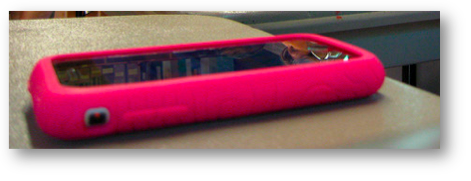
Totally better than ur boyfriends iphone AM I RIGHT ladies?

From the shape of the image, and fact that my Facebook photos are private (I’m guessing Lisa’s are too), it’s likely the marketer got it from the SEOmoz Flickr stream, where it’s public. It certainly shows no signs of being cropped by Facebook, which you’ll often do to a profile picture. Throw on the generic interests, and you’ve got yourself your marketing shell.

But Hayley Mansfield ain’t no Stan Malone. Top level analysis shows that she has no substance, but why was Malone believable and Hayley not? Of course, the irony is that Malone itself is fiction and the invention of Hayley isn’t, but there are some key things in Williams’ story that you really should pay attention to if you want a fake avatar to make its way into the mainstream.

Paul and his flatmates Tristan and Megan didn’t intentionally choose Malone’s circumstances for success, but they were still effective. Firstly, they chose a profession for their character in which the public was inherently interested. The story takes place in 1984 and Malone is a talented athlete. The Los Angeles Olympics are approaching. New Zealand enjoyed a golden era of athletics in the 1960s and 70s (remember?) with the likes of John Walker and Peter Snell dominating world track. 80s Kiwis expected to see good distance runners perform at the Games, and Malone could provide them with that. His inventors timed their invention to coincide with a large event and public interest, even though they didn’t intend to. Remember this. People’s interests move in trends. What will you tie your project to?

Secondly, they didn’t use someone else’s photo. The fake picture of Malone was Paul in a wig. Before the Internet, with Malone “exceptionally shy” and living overseas, a mediocre-quality picture did the trick. Nowadays, you would need a very good disguise of someone who knew he was being used if he were to become a national hero. Alternatively, you’d buy rare stock photos that were unlikely to be found or used by someone else. You couldn’t just take a photo of a real person who would be seen on the street, and you can’t just take the picture of two real people from Flickr who might one day come across it. It was a coincidence that Lisa and I work in marketing, but that sort of chance isn’t once you really want to take.

Thirdly, Tristan. Paul and Megan didn’t try too hard. They set something in motion and then the story created itself. From the book:

The modern day equivalent of this is getting stories written about your subject. It’s getting links. During the years I worked at SEOmoz, I saw things we did and said debated and discussed and passed around until sometimes, the end message was quite different to that with which we’d started. Sometimes this worked in our favour and sometimes it didn’t, but if the goal is to create a phenomenon in which people are interested, chat is gold. The New Zealand public made up their hero in more detail than the three flatmates ever tried to do.

The flatmates did not join whatever 1984’s Facebook groups (women’s magazines? Sports talkback radio?) were with some fake profiles–Malone’s sisters and ex girlfriends and former rivals, perhaps–and tell stories of his past, or talk about how awesome he was and why he should be chosen to carry the flag at the Games. They seeded something so that other people did that. Real people. Hayley Mansfield was undoubtedly created in order to do the former.

Earlier in 2008, prior to Favatargate, Lyndon Antcliffe wrote about that thirteen year old and those hookers. Before Lyndon admitted that the story wasn’t true, the media (namely FOX News) did go a little Malone on it, reporting on the issue and undoubtedly casting opinions on the boy, the parents, the hookers and what it meant for society in general. People would perhaps have even hypothesised about the identity of the family if Lyndon had been more specific about the location (it was only reported to a state level: Texas). He did what great marketing does: set something in motion. Hayley’s generic likes and interests, plus the fact that she won’t have any other photos of herself unless they’re all of Lisa Myers or me, plus the fact that her inventor likely doesn’t have much interest in making her a deeper character, limit her potential.

I am not going to make excuses for lazy Facebook profile making, but I do understand how hard it is to create a realistic fictitious character. I’ve tried it. It’s hard to know what a stranger whose characteristics are different to yours would do or write or think: Sarah Carling wrote a brilliant piece about writing anonymously on SEO Chicks during her interview for the role. It’s hard to be someone you’re not, because you’re very used to being you. It turns out that I’m not good at powering a fake social media profile, but I’m far better at it than the person who chose Lisa’s and my photo.

Awesome marketing stunts usually get found out, and people get upset. I personally don’t mind a fake story (I lived in the US where their TV reporting is largely hyped up garbage, and now I live in the UK where a lot of newspaper reporting is the same, so what’s an actress with a whiteboard when Obama’s apparently a Muslim extremist?). I believe, however, that these aren’t necessarily also awesome marketing, minus the dramatic qualifier.
Malone gets here; Hayley’s wares do not

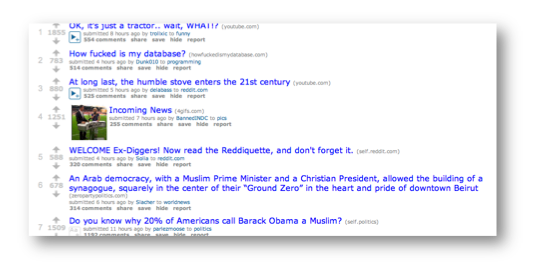
Awesome marketing is under the radar. It is the girl on Facebook whose activity isn’t extreme enough or banal enough to look fake. It is the post on Reddit that isn’t crazy or staged enough to be unbelievable, but which is good enough to set a story or meme or idea in motion. It is a story from 1992, set in 1984, that displayed a lot more imagination than someone eighteen years later with the technology of 2010 under their fingers and a photograph of two generic blonde girls in a London pub.

NZ Flag… eclipsing the Valencian sun by  ednobofin on Flickr

Pink iPhone at the retreat by micala on Flickr

Twitter is Disturbingly Bad for Our Collective Consciousness

Apr 05
2010

“Twittering stems from a lack of identity. It’s a constant update of who you are, what you are, where you are. Nobody would Twitter if they had a strong sense of identity.” – Oliver James in the Times Online

Consider the difference between these two messages.

Consider how each would make you feel if you didn’t know how to watch Hulu whilst outside of the United States. If you saw either message on Twitter, it is likely would have been written by someone you chose to follow. Connecting with other Twitter users lets their messages into the space of the follower: into our computers, into our mobile phones, but most importantly and most detrimentally, into our minds.

Consider being slowly inundated with messages over a period of years that take the second tone, rather than the first, because no matter who ones follows or avoids, the second tweet is indicative of a popular form of commentary on Twitter. It is used to gain attention, to be noted as edgy and smart, and it is so very bad for our collective health online. However, it barely dips its toe into a pool of appalling behaviour that we have come to accept as social networking and healthy online debate.

Additionally, we have created a world where one’s very existence is validated by a staccato-like life casting, but one where everything cast is created and tailored for other people. Nothing we do or say on Twitter is done for ourselves; it is done to impress, humiliate, berate, influence or entertain somebody else.

I Exist by C-Monster on Flickr

We have allowed ourselves to become a society that values two things that generations before ours did not:

  1. Broadcasting the fact that any individual exists, as validated by the attention of others.
  2. The ability to deliver bile in the most succinct manner possible, whether passive aggressively or as direct viciousness.

None of the positive uses of Twitter could make up for either of these appalling values.

The positive uses of Twitter hardly need to be relayed here. The primary benefits of the service are the quick distribution of information, specifically for the purpose of viral marketing, and the productive discussion and banter that was meant to be Twitter’s main purpose. Neither of these functions, however, is important or powerful enough to override the horrifying values above.

The psychology behind needing validation and attention is one hazy. It is human nature to value positive attention, and for some people–people like me–even feedback not inherently negative can be taken as a harsh judgement. When I had a Twitter account, there were periods where little bound me from broadcasting what I was doing. Any situation vaguely negative or positive had to be shared, and not just shared with one person. I maintained two accounts for over eighteen months: One was public and had about 2,100 followers (many of which were undoubtedly automated marketing accounts). One was private and followed by about 30 of my friends. I promise that most of what I say here is not academic pontificating about the actions of other people. I lived this.

The mindset of people who must share the majority of their experiences has devolved to the extent that an event has no significance unless it is broadcast.

The Web is now crawling with philosophers who are terrified that the tree makes no sound if it falls and no one hears it.

If you couldn’t share it, could you still value it?
Broken
by kozumel on Flickr.

In Andy Pemberton’s Times Online piece A load of Twitter, various psychologists and writers wax lyrically about Twitter being a means to closeness. They paint a picture far stranger (sometimes bordering on outright weird) of our need for constant communication and assurance than that which I may be tempted to pursue. The piece did, however, highlight some of the most incredible things about Twitter as a pacifier: “a giant baby monitor”, as the piece calls it, or at least, a ridiculous security blanket.

No one, however, including people I’d spoken to offline about this, better conveyed the worst thing about Twitter than clinical psychologist Oliver James in Pemberton’s article:

“Twittering stems from a lack of identity. It’s a constant update of who you are, what you are, where you are. Nobody would Twitter if they had a strong sense of identity.”

Who would you be if you had no way of telling everyone who you are?

It’s not as though I found out. That I maintain a blog alone negates the idea that I, personally, have removed myself from delivering my opinion when I feel like it, and I still have a (private) Facebook account. However, removing myself from Twitter relieved me of two very unhealthy habits:

  1. Thinking that my actions or whims and thoughts were important enough to constantly share.
  2. Thinking that the actions, whims and thoughts of other people were important enough to influence my life.

The freedom of not being able to share life’s minutiae is more satisfying than the ability to share ever was.

In addition, Twitter made me a poorer writer. Despite having spent years studying English and, in particular, composition, I am not sure what it is about shortened text–specifically that which must contain fewer than 141 characters–that invites people to be snide and abrasive. I assume that a lot of it is delivery. Imagine if I tried to convey the sentiments of this article in a tweet. No development of argument; no clarification of thought.

I could think and write very well in short bursts; my sentence structure probably remained fairly similar, but my ability to deliver the sort of coherent paragraph that I was once brilliant at, was severely lacking. Thought development and the art of making sentences complement, not stand alone, from each other is one of the defining characteristics of good writing. I had taught myself to think in 140 character bursts: short projectiles of thought that English 101 teachers would mark down for inconsistency and lack of flow.

I owed myself, and some excellent teachers, a lot more than that.
Writing Tools by this is your brain on lithium on Flickr

But it is short, jabbing little sentences and baby paragraphs that allow words to sound even more vicious that perhaps they were intended to be. Add the infamous behind-the-keyboard bravery, and a world is born where the descent into negativity is entirely natural.

Here, I see you stop reading. People are awful online, aren’t they? This, however, is hardly the height of the problem.

It’s not productive to again cover the fact that people are nasty to each other on the Internet. Far more interesting and less-explored is the tendency people have to crave and fuel fights created by others and in which they should have no personal interest.

I shy away from using real people, but much of this rings hollow unless we can look at examples. Recently, I came across a post by technology blogger Loren Feldman. Feldman had received a series of offensive messages and and had blogged about them. He proceeded to keep blogging and tweeting about the sender of the messages in a style for which he’s quite well known.

His campaign against any individual can be largely written off as the actions of a person known for purveying heated damage campaigns. Every couple of weeks, Feldman apparently has a new target, as well as some staple nemeses. It is not the simple fact of Feldman, or any similar individual, says these things. It is the collective response from a crowd hungry for blood. It is the modern day equivalent of gathering to watch a stoning, a hanging.

We tend to view cultures older than ours as primitive, but our behaviour when we cheer on the likes of Feldman are no different to the reactions of our ancestors who congregated in public to watch the humiliation and harm of somebody else.

They all agree: You’re an idiot, but you’re worth 140 characters of their time.
crowds by Dieter Drescher on Flickr

Nowadays, people you know show their support not by hurling stones or stoking a fire, but by retweeting nasty comments, adding their own two cents to a debate that does not involve them and otherwise supporting the attack on a stranger. Some of this is likely done in the subconscious vein of self-preservation: we’ve seen the campaigns launched against others, and if we stay on the crowd’s good side by agreeing, we know it’s less likely we’ll be up next. Feldman’s content management system grabs mentions of a post on Twitter and adds the tweets as a comment on the post. Including comments left on the site and Twitter mentions, Feldman’s videoed mockery of his latest target’s product received (as of today) 169 responses. The vast majority of them are in support of the video. This number doesn’t include the tweeted conversations to which a large crowd contributed regarding the offending individual.

A crowd of people enjoying and contributing to the mockery of a stranger. We haven’t moved on a damn inch.

That the original message Feldman received was unnecessary, and its sender might be a relatively unpleasant individual, is of no consequence. Neither is the original point of any similar campaign, such as that which took place recently regarding a man who wanted to standardise the verification of SEO abilities. What matters is that hundreds (in some cases, thousands) of people pick up a stone and throw it in order to take part in the action. Nowadays, most of this happens on Twitter. If it doesn’t happen on Twitter, Twitter fuels the discussion. It is a benign technology that is routinely used to perpetuate the worst instincts of humankind.

There are two possible outcomes from this sort of behaviour; the first is more prevalent, but the second is worth mentioning as well.

The overriding hypothesis of what the heartfelt support of other people’s battles entails for any one individual is that that person becomes unhappier, less likeable, more prone to nastiness and far more likely to live life with a less positive demeanour. No one means to let interaction online, least of all on Twitter, affect them like that; however, long-term exposure to anything will leave a mark. Total immersion is proven to work in a range of physical and psychological ways: it is a very effective way of learning anything from a language to a game or activity. If a person immerses themselves in the sniper-fire style battles that burn and flare within Twitter, they adopt the cantankerous, impolite attitude where the feelings of others mean less and everyone is fair game for attack.

This was true for me. If I’d followed an online fight too closely, or if I’d taken part, I would be less positive offline. None of us can afford to let more negativity into our lives than that which we can’t control. During 2009, I especially learned the value of seeking the positive and the progressive. Why invite unpleasantness in when it often finds its way in regardless? Like anything you ingest, you carry the information you read, and its tone, with you wherever you go.

Venting anger or snark on Twitter didn’t improve my mood either. It just created a semi-permanent record of the emotion: the exact opposite of what was needed.

Listening too hard to the opinions of others has also resulted in people more definitively assigning other people worth. A person’s social media presence (mainly dictated by activity on Twitter) has become synonymous with how much they matter. At the recent Think Visibility conference in Leeds, attendees’ badges displayed their Twitter handles and some statistics about their activity therein. A harmless meme and an efficient way to exchange Twitter names, but one which subconsciously states: If you do not tweet, who are you to us? There are now, more so than ever, people who “don’t matter”.

On the other hand, perhaps living a fight vicariously through a Loren Feldman is good for us? Could a case be made that letting someone else get dirty for the sake of public belittlement ensures that people at large don’t do it themselves? If we can focus on a common enemy and let a vocal few deliver the blows, perhaps our aggression and discontent can escape passively. Are we less likely to kick off at someone in our real lives if we’ve released some angst by retweeting an unnecessary piece of snark at somebody we don’t know? I personally don’t believe this, but it is the counter-argument to that which I’ve made, and is worth mentioning.

I understand the counterpoints. The overwhelming majority of my friends use Twitter, and they will say to me:

“I get a lot of benefit from it. I share links to my writing and to other things I’ve enjoyed. Twitter introduced me to business opportunities and bettered my reputation. You just couldn’t handle yourself properly on there, or control your emotional reactions to what you read.”

Even if you think you can operate something like Twitter entirely responsibly, please give these points a second thought. Have you ever been left upset by a negative experience had via Twitter that you would never have had if Twitter were not part of your life? Do you ever find yourself gripped by the need to tweet experiences or thoughts, and would you be frustrated if you weren’t able to or didn’t share them? Have you ever laughingly retweeted or replied to a little snippet of bile, or linked to a cruel post? Are you sure your relationship with Twitter is that much different to mine?

I expect my positive experience with deleting Twitter is a sensation common to many people who’ve quit something that was bad for them. In the past two months, I’ve narrowed the positive change down to the points explained above: the ability to enjoy life without proving my, or its, existence, or constructing an ideal real-time version of who I am for other people, and the ability to be ignorant of the primitive promotion of public brawling.

I used to view Twitter as quite central to how I lived, but it is also freeing to see how little time needs to pass before something that was actually a very unhealthy habit is gone entirely.

Texting Twitter by kerryvaughan on Flickr.

[UPDATE] Whilst I recognise the inherent irony of including comments from another social network here, some of my friends had really good points about this on Facebook, and their points contribute to those left in comments here really well. Profile is private unless we’re connected on Facebook. If I get their permission, I’ll post the thread as an image here.

[UPDATE II] They agreed to let me share their Facebook comments :)

Running Into Obsession: The Church of Arthur Lydiard

Feb 18
2010

“They still say I’m wrong, but it doesn’t bother me.”
- Arthur Lydiard, to Lochaber Athletic Club, June 1987

In the haze and cloud that rise off Manakau Harbour, the hills that stretch beyond West Auckland are known for little but their slightly flashy suburbs and relative inaccessibility from the city by public transport. The city’s better off citizens find their homes at the end of evergreen crescents and avenues for a few miles up into the Waitakere Ranges, but after the clean streets of Titirangi give way to bush, Auckland’s city limits are thought to come to an end.
Read the rest of this entry »

The StreetView Divers and The Case of Internet as Serious Win

Feb 11
2010

It’s said that the London Underground is one of the least friendly places in the world, where people will avoid making eye contact with each other, let alone speak. I don’t find this to be as true as the stereotype suggests (on the Central line, I had a hilarious exchange with a girl about American politics, late at night on November 4, 2008). However, as unfriendly a place as the tube can be, it pales in comparison to the Internet.

What I wrote here, plus the comments, speak of how unnecessary the online culture of gross impoliteness really is. Often, however, it is far easier to adhere to a better way of behaving if you have something to fall back on: the behavioural equivalent of the mnemonic device. This won’t work for everyone. Perhaps it won’t work for anyone besides me, but I saw something yesterday on Google Maps.

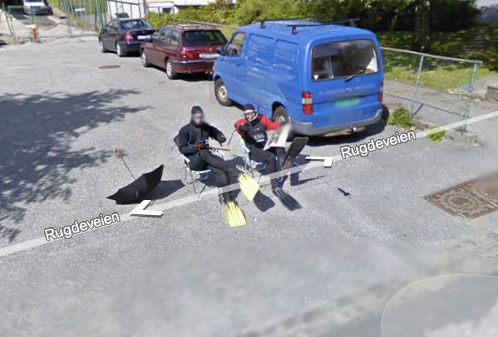
We’re in Norway, and we’re chilling on the side of the road in our diving gear.

Just reading the paper, as you do, in your wetsuit, with your umbrella.

So when you see the Google StreetView car, what other option do you have?

You chase that bastard down the road.

You chase him up the hill.

In your wetsuit, with your rake, you chase him until you can’t run any further in your flippers.

I don’t know why these guys chose to chase the Google car. Perhaps this is a protest against Google’s indexation of their neighbourhood. Perhaps they wanted to be on StreetView in the same way that people want to bob about behind field reporters’ heads on TV (although I don’t believe Google exactly publicises its drive-by schedule for fear of this sort of activity). Perhaps they were hanging out in their driveway in Norway in their diving suits, reading the paper, when they fulfilled my friend Danny Dover’s dream and were allowed the opportunity to chase the StreetView car.

As a point, Danny and our friend Sarah did appear on StreetView. Danny, however, was not as lucky as the divers. He never saw the car.

The reason for the chase doesn’t matter to me. My job aside, this is what I like about the Internet. The random pieces of win. The parts of the Internet where you find true humour, no matter what its original purpose. It is reading an elaborate story without knowing that you’re going to be Bel Aired. It’s Rick Rolling Kurt Cobain. It is not publicly calling people names, starting blogs for the purpose of handing out curse-laden insults or posting shortened versions to Twitter.

Although the horror of our collective behaviour on the Internet has slowly been occurring to me for quite some time, this is my favourite metaphor for Internet as serious win. Two blokes running up a road in Norway in wetsuits. Think of this next time it seems like a good idea to write something horrible. Have a grin; do something else.

And the Underground? London in general? I will never ride the tube or walk the streets of this city in the same way again after watching this programme from Channel 4 about the incredible bravery Londoners extended to strangers on the Circle line on 7/7/2005. Now I sit on the train and think about what sort of person is probably sitting opposite me: a stranger who doesn’t want to make eye-contact, but someone who for the grace of God would be a hero.

It’s hard to walk around with a bad attitude when I think of strangers like that. It’s hard to be deliberately nasty online when I’m thinking about the little corner of the Internet where two blokes run up the road in scuba diving gear. I’d rather exist in that corner.

Be good to each other.

I Don’t Drink

Jan 23
2010

During the early 1990s, the principal of the Lower School at Marsden–a horrible private girls’ school to which I was forcibly sent for eight painful years–was a woman called Mrs Leach. I remembered her insulting a girl in my class once for “only ever looking out for number one” and not considering others, and then (it could not have been more than a week later) berating someone else for not minding her own business. “Look out for number one!” she had shrieked in front of the entire school assembly. Even at the age of nine I had been able to see the condradiction. I wasn’t sure, however, in which instance she had been right.

At twenty-five, I think she was right the second time.

One needn’t be consistently loud in order to maintain an independent, intelligent opinion. Quite a few people appear to believe that if one does not make one’s opinion (especially one’s disagreements) luridly clear in public, whenever possible, that one must be an agreeable “sheep”, or perhaps have no opinion at all.

Routinely, I disagree with people I respect. I disagree with people I love. I’ve had differing opinions on swimming with my father, and I regard him as the best coach I’ve ever had. My ideas on the limits of acceptable SEO practices sometimes differ from those of Kate Morris and Rob Kerry, both of whom are highly competent professionals. Some time around the last U.S. presidential election, I realised how pointless and damaging it was to regard party politics as important when it came to my friends.

However, most importantly, I learned that it’s not polite, nor necessary, to point out disagreements in public, as if crudely spray-painting them on a conveniently located wall, especially if the person with whom one disagrees is a respected friend. The point at which I knew this to be true was when a good friend of mine left a snide comment on something I cared about… the opinion was valid, but its public nature and unpleasant tone made me wish we were more private and respectful with our opinions when the subjects are close to us. We all have email accounts, telephones and even local pubs in which to maintain rational relationships and debates. Why must being quiet equate to being devoid of independence?

Of late, I can only recall publicly disagreeing with someone once. I don’t even find it satisfying. Even the following private messages–some from strangers–who agreed with me, didn’t really matter. I could have held as true to my beliefs if I’d maintained my silence, and in the end, I didn’t change anything.

Be polite and respectful both in public and private. Because I avoid publicly humiliating people I care about, it doesn’t mean I think they’re always right. Most of you appear to have let your Twitter accounts and blogs, and the comment section of other people’s websites, convince you that a person’s silence equates to the lack of an opinion, especially one of dissent.

And ponder this beautiful irony (one of many stumbled across of late). On each side of every debate, every clique, every disagreement and every set of beliefs, people claim that their opposing numbers are drinking the opposing team’s Kool-Aid. Next time it seems apt to accuse somebody of such consumption, consider whether the problem is actually that the person isn’t drinking yours.

Domain Renewal Group. Yuck.

Nov 30
2009

Here’s one about ethics in marketing and advertising, and I am not, for once, talking about buying links. Advertising is, to a large degree, an exercise is fooling people into handing over their money. This morning, however, I was presented with a form of marketing that, to my mind, crosses the lines of acceptability.

The post arrived. I was handed a letter and plain white envelope. It was, on first glance, a bill. The point, however, is that it wasn’t.

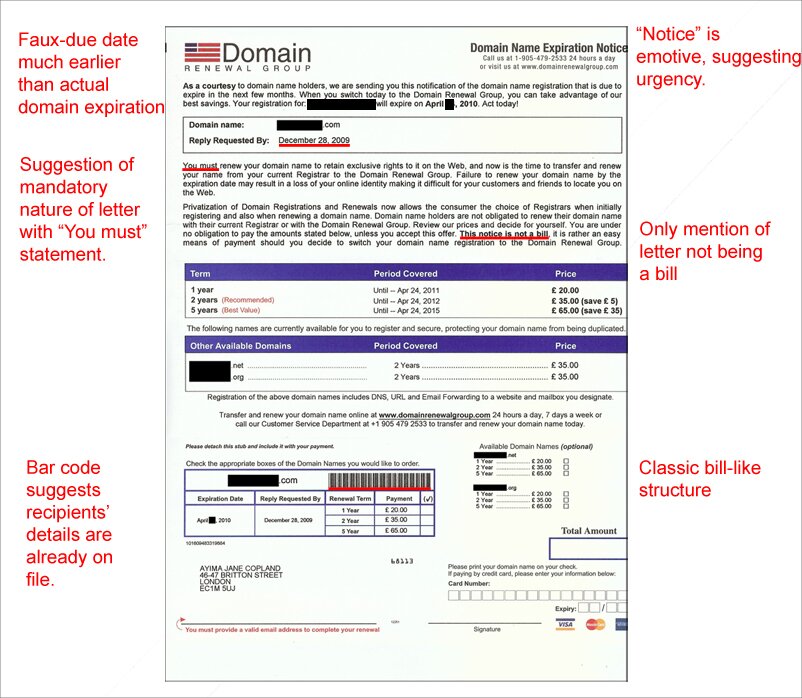
These notices are relatively common, although we ignore them to the detrminent of online marketing’s standards and reputation. They try quite hard to make it seem as though one needs to pay in order to keep one’s property. The text states in bold that the letter is not a bill (and I didn’t even need to get past the first couple of glances to know what was going on), as is shown in the image below. However, without my highlighting (and due to other features of the letter, which I’ll also cover), that one statement hardly stands out. Additionally, it arrived in the post. We’re far more accustomed to ignoring emails than to ignoring official-looking mailed documents.

These notices certainly try their best to look like a bill, read like a bill and barely highlight the fact that they aren’t. From a company called Domain Renewal Group (whose SERP is already a #facepalm fail), the letter explains that “in the next few months”, a domain the recipient owns is set to expire. As it turns out, the domain referenced in my letter does not expire until late April, 2010, but the date on the letter that catches the eye is December 28th of this year. The goal of the letter is to have a person transfer registration to Domain Renewal Group from their current registrar. The fine print makes clear that the move is not mandatory, but the layout and tone of the letter is quite obviously deliberately structured to scream “invoice!”

Click the image for a full-sized version

To my mind, this sort of marketing seeks to exploit a couple of things. Firstly, a lot of people tend to operate in a state between busy and lazy. Especially if a person is used to receiving scores of notices, bills, invoices and receipts, they can become lazy about the fine print. Secondly, the vast majority of people do not “get” Internet. I dare say over half the people reading this don’t know how domain registration works, and most of you are probably geekier than average. A large number of people will, at least on initial inspection, assume that this is something they need to do in order to keep their website.

Ignorance, laziness and the need to move onto other tasks combines: “This note says we need to pay £20.00 by December 28 to keep that domain? Stick it on the card we use for incidentals.” People’s natural reaction upon receiving an invoice tends to be to jump to the bottom, where the numbers are, to figure out what they owe. Again, only once does the notice state that it isn’t a bill, and it doesn’t state this in a noticeable manner.

I estimate that a huge portion of the Domain Renewal Group’s sales are borne of this partnership of misunderstanding and hurried bill-paying. For a couple of times more money than is necessary to renew a domain name in most cases, people transfer their registration to this company.

Question time: Does this go too far? I say it does, but I work in the online marketing community and I would guess that some of you will disagree. “It’s in the fine print; hell, the print ain’t even that fine. In neatly printed Arial, it says ‘This notice is not a bill’. If you fall for this, it’s your own fault.”

Indeed, the practice isn’t illegal. It is, however, a disgusting way to advertise and it isn’t exclusive to domain registrars. Make it seem like a potential customer owes you money (and that they’ll lose something important to them if they don’t pay). Classy stuff, Domain Renewal Group. I can only hope everyone takes your name to Google before parting with their cash.

Spam wall via freezelight on Flickr

The BBC Uncovers Image Search Algorithm

Nov 26
2009

We can become a bit smug when it comes to the BBC. We generally view its level of journalistic integrity to be a bit above that of its cable TV counterparts. Last night, however, those of us involved in SEO were surprised to note that even the Beeb’s esteemed reporters aren’t immune to poor research. As is always the case when you notice something untrue reported as fact, you wonder how many facts you hear on a daily (hourly?) basis that are woefully under-researched.

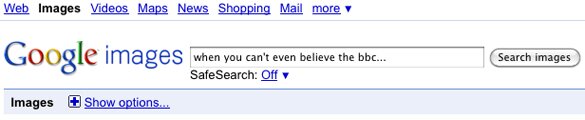
The BBC news report I was watching was about the Michelle Obama / Google Images incident. A crudely Photoshopped, offensive image of the First Lady was ranking atop Google images for her name. In an explanation of how such a thing could occur, Rory Cellan-Jones, the BBC’s Technology Correspondent said:

Google doesn’t decide what comes top when you search for a word or an image. That’s determined by a complex formula. But it basically boils down to the fact that the more people click on a certain site, the higher up the list it comes.

An audio version of this part of the report is available here. For a short time, British readers can view the entire segment on iPlayer (between minutes 14:45 and 17:10). At the end of the piece, Cellan-Jones says again:

For now, the offensive picture of Michelle Obama has disappeared from Google’s search results, but if web users find it elsewhere and click on it, then it will rise up the search engines list once again.

Incidentally, my good friend Ciarán Norris was providing an accurate description of how it happened on Radio 5 at the same time (1hr, 26min in).

And it was Ciarán who figured out why the Beeb most likely said such a thing. A report on their news website stated that “the search engine’s results get to the top based on popularity, not because of any ranking system by people”, a statement apparently given to them by David Vise. There is nothing particularly untrue about that, but the BBC have misinterpreted “popularity”, taking it to mean clicks, not links. No one bothered to check out Vise’s statement or make sure they’d understood him properly. Thus, it was reported to the nation that it was users clicking on the offensive picture of Michelle Obama that pushed the picture to the top of Google’s rankings.

Of course, there may be some ounce of truth to the clicks idea, if you believe that Google closely monitors click-through and bounce rates. However, not once in the piece were links–the currency of SEO–mentioned. Taking into account that click-through and bounce rates are highly likely to be very small ranking factors, there is no way even a small amount of research would have backed up the statements made in the report.

What we’ve learned, we already knew: journalists need stories to go to press nowish and don’t have much time to put together stories to feed the public their daily news. The BBC found a quote from an expert; it was just a little misunderstood. However, recognising such mistakes certainly makes me wonder what else is reported to us as simple fact that is actually quite badly misguided.

Sidewalks of A1A

Sep 10
2009

Slide down into the sea
Twelve hours on your feet
Get the tide to wash you away
Thousands and thousands of days
And someone you never meet
Signs a check you get every week
You try and you still can’t forget
All the strangers that you have met

Please be good to each other.

drewshoots on flickr / patty griffin – florida


Facebook Security Leaks–In Notification Emails

Aug 08
2009

My riveting life, which today has involved swim practice, a four hour nap and couple of hours on Skype with my mother, became ever so slightly less dull (well, not really) a couple of minutes ago when my mother made one of my Facebook pictures her profile picture. Apparently, Facebook emails you when someone does this. The email I just received, however, had a load of information in it that had nothing to do with me or my mother. It appears to display wall posts from people I don’t know, nor am connected to on the site. I also have no idea what language this is:

What is going on here, and are all of us having things from our profiles emailed to others accidentally?

They’re Naked

Jul 13
2009

The emperor has no clothes.